New Product Launch - Edgemere 2.0
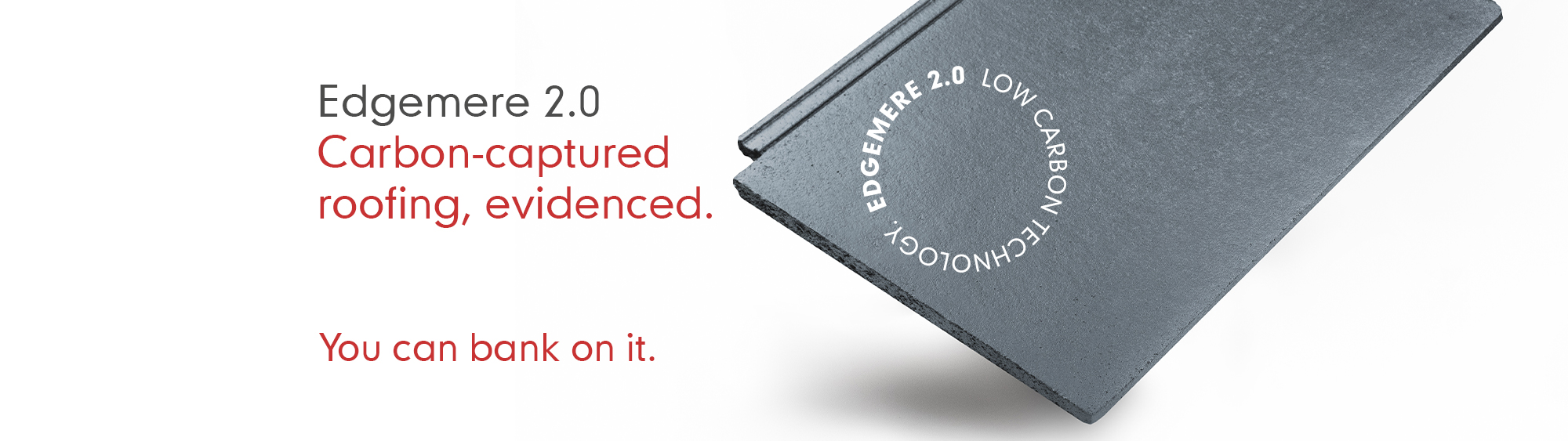
Marley launches Edgemere 2.0, the first UK roof tile to use carbon-capture cement technology
In a first for UK roofing, Edgemere 2.0 combines Marley’s well-known Edgemere concrete tile with carbon-capture cement technology and Carbon Bank evidence supplied for every order.
For the public sector, and increasingly housing providers, product-level carbon evidence is becoming part of the specification process. In a UK first for concrete roof tiles, the Edgemere 2.0 offers a product that provides documented evidence on cement carbon capture.
Edgemere 2.0 expands the Edgemere range by offering a low carbon option with a Global Warming Potential (GWP) of just 1.86kg CO2e per m² from cradle to gate, whilst retaining the familiar thin leading edge, technical performance and dimensions of Edgemere together with a Green Guide A+ rating and BES 6001 Excellent certification.
Carbon capture and Carbon Bank evidence
- CO₂ from cement production is captured at source, before it enters the atmosphere, and permanently stored beneath the seabed.
- The carbon saving is then recorded in the publicly available Carbon Bank.
- The Carbon Bank allocates captured and stored CO₂ reductions to specific Edgemere 2.0 orders, with full end-to-end traceability through an Environmental Attribute Certificate (EAC).
“Edgemere 2.0 is a significant step forward for Marley and for the roofing industry,” said Stuart Nicholson, Managing Director at Marley. “By introducing the UK's first concrete roof tile to use carbon-capture cement technology, we’re supporting the industry's transition to lower-carbon construction, with a documented carbon-evidence trail supplied for every Edgemere 2.0 order”.
Edgemere 2.0 is available in Smooth Grey. For more information, visit marley.co.uk/Edgemere2
About the carbon evidence and end-to-end traceability
*Edgemere 2.0 is supported by Heidelberg Materials’ EvoZero® carbon captured near-zero cement, enabled through the first carbon capture facility at its cement works in Brevik, Norway. To avoid the transport emissions that would be incurred by shipping from Brevik, Edgemere 2.0 CO₂ reduction can be transferred and attributed using locally sourced Heidelberg cement.
A Carbon Bank withdrawal is made to reduce the corresponding Global Warming Potential (GWP) of the locally produced UK cement to zero. The carbon reduction is recorded in Heidelberg Materials’ publicly available Carbon Bank, which allocates captured and stored CO₂ reductions to each specific Edgemere 2.0 order, with full end-to-end traceability through an Environmental Attribute Certificate (EAC).