Fibre cement weatherboard cladding: FAQs
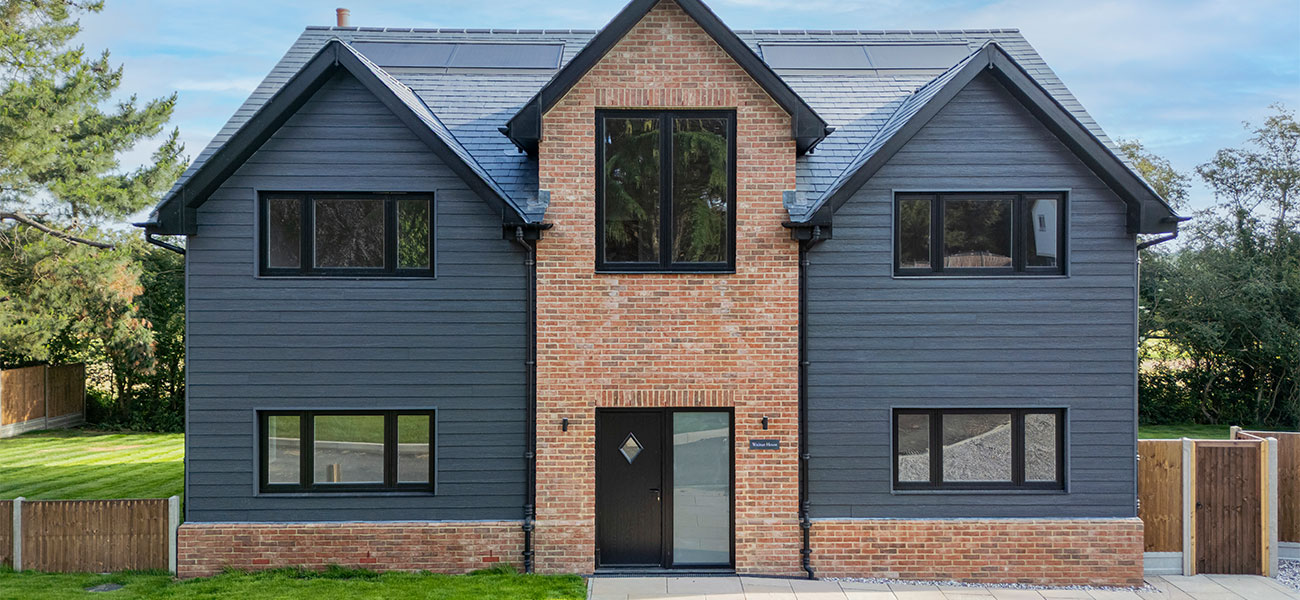

Fibre-cement weatherboarding is a popular choice for residential and commercial cladding projects, thanks to its durability, minimal maintenance and weather resistance. In this series of FAQs, we answer some common questions about its performance and project suitability.
What is fibre cement?
Fibre cement is a building material that is highly durable ,but also easy to cut and shape. It is made by combining cement, sand, water and cellulose fibres.. The boards are autoclaved – where heat and pressure are applied. This process accelerates the cement reaction, creating a strong, hard material.
What is weatherboard cladding?
Weatherboarding is a type of external cladding. It comprises long planks that are typically installed horizontally in an overlapping pattern. Traditionally, weatherboards were made from timber, but the use of fibre cement is increasingly popular due to its durability, water resistance, fire performance and minimal maintenance requirements.
Are fibre cement boards waterproof?
Fibre cement boards are not waterproof, but they are water-resistant. It’s a common misconception that it’s porous like masonry or concrete and absorbs moisture through capillary action. In fact, fibre cement is much denser than these other materials, with fewer air pockets to take in water. This makes the boards mostly impervious.
To ensure the rain resistance of a Marley Weatherboard wall, any on-site cuts should be treated with Marley Weatherboard touch-up paint. Weatherboard planks should be securely installed with the correct overlap and with appropriate fixings to resist wind-driven rain and to help protect the building envelope. Suitable drainage and ventilation should be incorporated into the cladding system to manage any moisture that may accumulate behind the boards.
Is fibre cement weatherboard cladding suitable for windy areas?
Marley Weatherboard is suitable for most UK exposure zones as defined in BS EN 1991-1-4. Eurocode 1: Actions on structures – Parts 1-4: General actions – Wind actions. It is commonly used in windy areas such as seaside and marine locations.
Correct installation is critical for wind resistance. Careful consideration should be given to how support battens are attached to the structure, particularly for masonry walls. For extremely high wind loading or severe exposure locations, please contact the Marley technical department for project-specific guidance.
Are fibre cement boards fire-resistant?
Marley Weatherboard has been fire tested and rated according to BS EN 13501-1:2018: Fire classification of construction products and building elements — Part 1: Classification using data from reaction to fire tests. The testing, carried out by BRE Global Limited, assessed the product's combustibility, smoke production and production of burning droplets. It achieved a rating of A2-s1, d0. This means:
- A2 – The material is non-combustible or has limited combustibility
- S1 – Very limited smoke production
- D0 – It produces no burning droplets or particles
What projects is fibre cement weatherboard suitable for?
Marley's Weatherboard fibre cement cladding can add unique visual appeal to new developments and is an ideal choice for refurbishment projects, enhancing the appearance of existing properties.
One common use is for solid wall insulation projects, where insulation is applied to the external walls of an existing property. Once the insulation is in place, the weatherboard can be installed, with attention given to ventilation and condensation control, in line with BS 5250:2021, the Code of practice for the management of moisture in buildings.
Marley Weatherboard may be used as a suitable cladding on a broad range of residential dwellings, including high-rise buildings, when used with a suitable metal frame system.
What fixing methods are used for fibre cement weatherboard cladding?
Marley Weatherboard planks are easy to handle, cut and fix using standard tools. They should be securely fixed to support battens or supporting frames using suitable screws or nails.
In addition, Marley offers a wide range of connectors, trims, and profiles to aid installation and produce an appealing aesthetic. Manufactured from aluminium, they are colour-matched to the Marley Weatherboard planks for a uniform and attractive finish.
For comprehensive fixing information and guidance, please download the Marley Weatherboard Fixing Guide.
Where can I learn more about fibre cement weatherboard cladding?
For more information about Marley’s fibre cement Weatherboard cladding, please visit our dedicated product page or download the product brochure. You can also contact a member of our technical team for project-specific information and specification support.
Disclaimer - The information shared in this blog is correct at the time of publication. Guidance, standards, and best practices may change over time, so if you’d like further clarification or the latest updates, please get in touch with the Marley Technical Advisory Team, who will be happy to help.