Low-carbon roofing products need more than claims they need proof
 The construction industry has become accustomed to products being described as green, sustainable or low carbon. These terms can be useful shorthand, but on their own they tell specifiers very little about how an environmental improvement has been achieved, which stages of a product’s lifecycle have been assessed or whether the claimed reduction can be traced back to a measurable action.
This matters as embodied carbon moves higher up the construction agenda. Operational energy remains critical, particularly as buildings transition towards electric heating and renewable power, but attention is also turning to the emissions associated with manufacturing and transporting construction materials.
Roofing products are part of that calculation. The roof may represent only one element of a building, but the materials selected for it contribute to the overall carbon impact of a new development or refurbishment project. When those choices are repeated across a housing programme, the cumulative effect becomes more significant.
The challenge for specifiers is no longer simply to find products carrying the lowest carbon figure. They also need to understand where that figure comes from and whether there is credible evidence behind it.
Carbon figures need context
A product's carbon footprint should never be viewed as a standalone number. Its value depends on the scope of the assessment; the unit being measured and the assumptions used in the calculation. For construction products, one of the first questions should be which lifecycle stages are included. A cradle-to-gate assessment generally covers raw material extraction, transport to the manufacturer and the manufacturing process itself. It does not necessarily include transport to site, installation, maintenance, replacement or end-of-life treatment.Two figures can therefore appear comparable while measuring different things. One may cover only factory emissions, while another includes raw materials and transport. A result expressed per tonne cannot be compared directly with one calculated per square metre of installed product without further analysis.
“Specifiers should always look beyond the headline carbon figure,” Daniel Redfern, Head of Marketing Communications at Marley, explains. “They need to know what has been measured, which lifecycle stages are covered and whether the declared unit reflects how the product will actually be used on the building.”
Clear system boundaries do not make a carbon claim less persuasive. They make it more useful. A properly defined figure allows project teams to compare like with like and understand where a product sits within the wider carbon assessment of the building.
The source of the reduction matters
It is equally important to understand how the reduction has been achieved. Some products reduce their footprint through changes to the material mix. Others use renewable energy in manufacturing, reduce transport requirements or improve production efficiency. Carbon capture and storage provides another route, particularly for sectors such as cement production where process emissions are difficult to eliminate.Cement is a major contributor to the embodied carbon of concrete products. Some emissions arise from the fuels used to heat the kiln, but a substantial proportion comes from process emissions released during the chemical conversion of limestone in clinker production. This means that switching to lower-carbon energy sources alone cannot eliminate the full carbon impact of conventional cement manufacture.
Carbon capture technology is designed to address these difficult process emissions by capturing CO₂ before it enters the atmosphere and transferring it to permanent geological storage. However, a claim that a construction product ‘uses carbon capture’ still needs explanation. Specifiers should be told where the capture takes place, what happens to the CO₂ and how the resulting reduction is linked to the product they are purchasing. “Carbon capture is a significant technological development, but the terminology can easily be misunderstood,” Redfern adds. “The important point is not whether a tile physically captures carbon. It is whether the cement route is supported by genuine captured and permanently stored CO₂, and whether that reduction can be traced to the order.”
Traceability turns a claim into usable evidence
It is especially important that carbon reductions are securely recorded within an independently verified allocation system that provides clear traceability. These models are already familiar in other sectors. Renewable electricity, sustainable fuels and responsibly sourced materials may be traded or allocated separately from their physical movement. This can support the development of lower-carbon production while avoiding inefficient transport or supply arrangements.
The same principle can be applied to cement. Carbon capture may take place at a specific manufacturing facility, while the carbon reduction is allocated to locally manufactured products elsewhere. This avoids transporting heavy cement over long distances simply to maintain a physical connection between the capture plant and the final product.
For the system to carry weight, the carbon reduction must be securely recorded and attributed to a specific order. Heidelberg Materials manufactures evoZero®, its near-zero carbon cement, using carbon capture technology at its Brevik facility in Norway, where CO₂ from cement production is captured and permanently stored. Rather than transporting that cement to the UK and creating additional transport emissions, the verified carbon savings are recorded within Heidelberg Materials’ Carbon Bank and attributed to Edgemere 2.0 orders manufactured using locally sourced Heidelberg Materials cement. An Environmental Attribute Certificate then provides order-specific documentation and traceability for the allocated reduction.
Transparent evidence helps procurement teams
The people specifying products are not always the only ones who need to understand the carbon claim. Procurement teams, sustainability managers, clients, investors and funding bodies may all require evidence explaining why one material was selected over another. An environmental claim that cannot be documented may be difficult to include in project reporting. It can also leave the organisation exposed if the methodology is later questioned.
Order-specific evidence gives project teams something tangible to retain alongside technical specifications, warranties and certification. It allows the carbon reduction to be discussed in procurement reviews and sustainability reporting with a clearer audit trail. Marley’s self-declared Product Carbon Footprint reports a cradle-to-gate GWP-fossil value of 1.86 kg CO₂e per declared square metre for lifecycle modules A1–A3. The declared unit is 1 m² of roof tiles laid at 10.5 tiles per m².
The figure is published within a Product Carbon Footprint calculated using One Click LCA and aligned with ISO 14040, ISO 14044 and EN 15804+A2. The document also makes clear that it is a self-declared carbon footprint report rather than an Environmental Product Declaration. Different forms of environmental documentation serve different purposes, and project teams need to understand what they are reviewing. Transparency about the type of assessment strengthens confidence because it allows the evidence to be considered on its stated terms.
“Credibility comes from showing the workings,” Redfern continues. “A strong environmental claim should explain the calculation, identify the assessment boundary and provide evidence of how any reduction has been assigned. That gives specifiers a much firmer basis for decision-making.”
Lower carbon cannot come at the expense of performance
Environmental information is only part of a roofing specification. The product must still satisfy the technical requirements of the building. A low stated carbon footprint will offer little practical value if the tile is unsuitable for the roof pitch, cannot meet the required weather performance or introduces unnecessary complications during installation.
This is particularly important for housing providers and housebuilders working with repeat designs. Switching to a lower-carbon product becomes easier when it does not require a change to established roof geometry, detailing or installation practices.
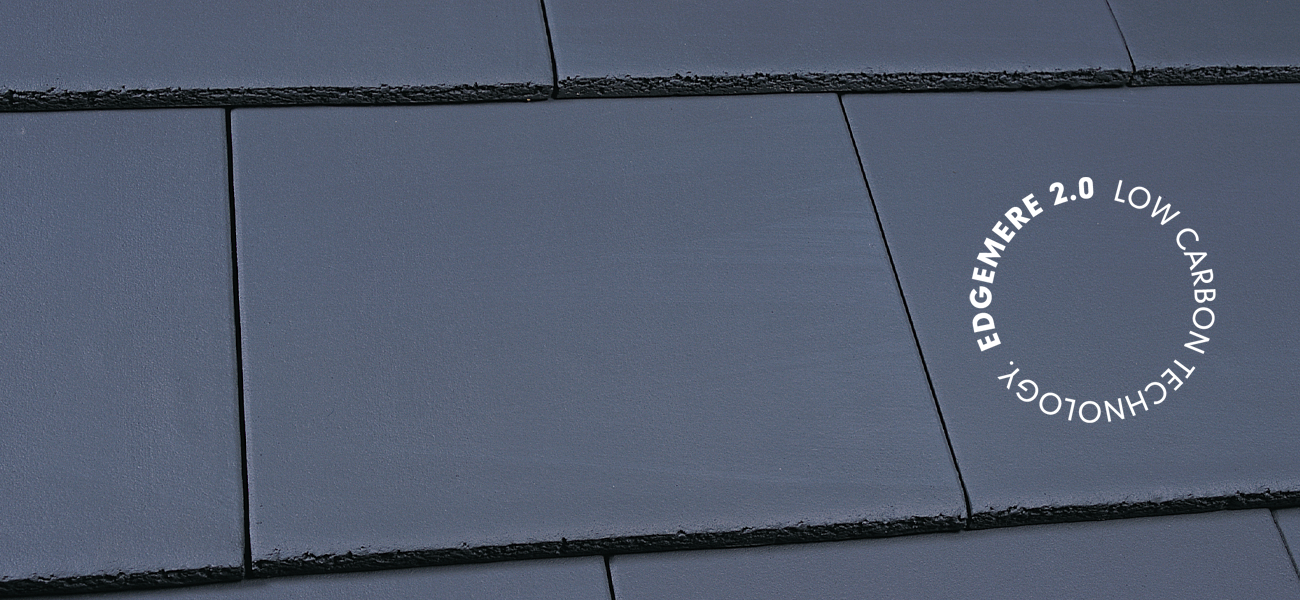
Edgemere 2.0 retains the same dimensions, thin leading edge and technical performance as the established Edgemere concrete roof tile. It is manufactured to BS EN 490 requirements and retains a Green Guide A+ rating and BES 6001 Excellent certification.
The innovation therefore sits behind the tile in the cement route and the carbon evidence supplied with the order. The visible product and its established specification remain unchanged. This balance matters. Construction will not decarbonise through environmental claims alone. Lower-carbon materials need to work within real projects, satisfy regulatory and technical requirements and be practical for contractors to install.
Evidence will become part of the specification
As embodied-carbon assessment develops, project teams are likely to demand more detailed and consistent product information. Manufacturers will need to support environmental statements with evidence that can withstand scrutiny, while specifiers will need to become more confident in interpreting the information provided.
The future may not be defined solely by whichever product publishes the lowest number. A figure supported by a clearly stated methodology, appropriate system boundaries and traceable documentation may be more valuable than a more dramatic claim that cannot be properly evidenced.
For roofing manufacturers, that means treating carbon evidence as part of the technical specification rather than as a separate marketing exercise. For specifiers, it means asking how a reduction has been achieved and what documentation will be supplied when the product is ordered.
Low-carbon construction requires better materials, but it also requires better information. When the two develop together, project teams can make decisions that are both environmentally and technically credible. To learn more about the carbon evidence behind Edgemere 2.0, or to discuss its use on a future roofing project, contact the Marley technical team.
Category: