The advantages to housing providers of using carbon-captured concrete roof tiles
 Housing providers are under growing pressure to reduce carbon emissions across their estates while continuing to deliver homes that are durable, attractive and affordable to maintain. Much of the focus has traditionally been on operational energy, including insulation, heating systems and renewable technologies. The carbon associated with construction materials is receiving closer and closer attention as organisations look more widely at the environmental impact of new-build and refurbishment programmes.
Roofing forms part of this embodied-carbon picture. Although no single material choice will determine the overall performance of a development, specifying lower-carbon products across repeated projects can make a meaningful contribution over time.
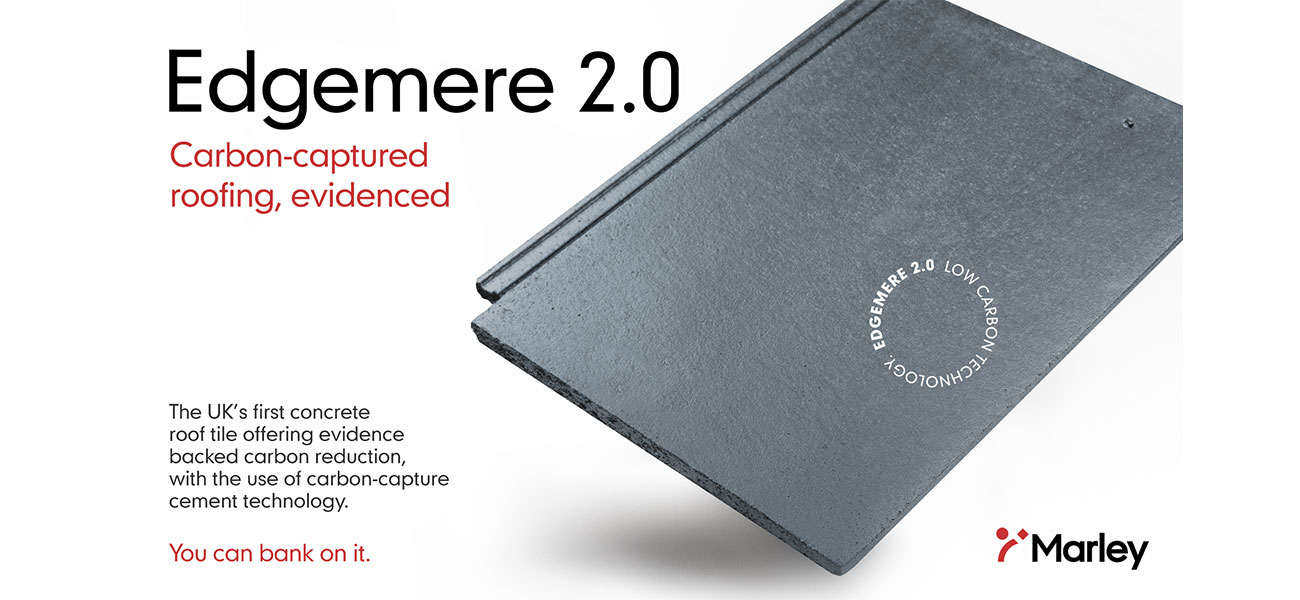
Carbon-capture cement technology offers housing providers a way to reduce the embodied carbon associated with concrete roof tiles without moving away from an established roofing format. Marley Edgemere 2.0 has been developed to provide this lower-carbon option while retaining the dimensions, appearance and technical performance of the existing Edgemere tile.
Reducing carbon across housing programmes
For an individual property, the carbon saving achieved through one product selection may appear relatively modest. The position changes when that choice is applied across a large housing programme. Housing associations, local authorities, private landlords and housebuilders may specify roofing materials for hundreds or thousands of homes over several years. Introducing a lower-carbon tile across those projects can allow reductions to accumulate without requiring a wholesale change in roof design or construction methods.This makes product selection an important part of longer-term housing strategies. A tile that can be used on both new-build and refurbishment projects gives housing providers another practical route to reduce embodied carbon alongside improvements to building fabric and operational energy performance.
“Housing providers are often looking at carbon reduction across an entire estate or development programme rather than one property in isolation,” Daniel Redfern, Head of Marketing Communications at Marley, explains. “Materials that can be introduced consistently across repeat projects can therefore contribute to a much wider sustainability objective.”
How carbon capture supports a lower-carbon roof tile
The environmental improvement behind Edgemere 2.0 takes place in the cement production process rather than through a change to the visible tile. Heidelberg Materials manufactures evoZero®, its near-zero carbon cement, using carbon capture technology at its Brevik facility in Norway, where CO₂ from cement production is captured at source and permanently stored beneath the seabed.Rather than transporting that cement to the UK and creating additional transport emissions, Edgemere 2.0 is manufactured in Glasgow using locally sourced Heidelberg Materials cement. The carbon savings achieved through capture and permanent storage at Brevik are securely recorded within Heidelberg Materials’ Carbon Bank and attributed to individual Edgemere 2.0 orders. An Environmental Attribute Certificate provides order-specific documentation and traceability.
Marley’s self-declared Product Carbon Footprint reports a cradle-to-gate GWP-fossil value of 1.86 kg CO₂e per declared square metre for lifecycle modules A1–A3. The declared unit is 1 m² of roof tiles laid at 10.5 tiles per m². The result is calculated according to ISO 14040 and ISO 14044 and follows EN 15804+A2; the report is not an Environmental Product Declaration.
Providing evidence for procurement and reporting
Housing providers increasingly need to explain and document the environmental decisions made during procurement. A general claim that a product is ‘green’ or ‘low carbon’ may not provide enough information for sustainability teams, funding bodies or other stakeholders.
The value of Edgemere 2.0 lies not only in the reduction itself, but also in the evidence attached to it. For each order, the relevant carbon reduction is securely recorded and attributed through Heidelberg Materials’ publicly available Carbon Bank. The allocation is supported by an Environmental Attribute Certificate, providing order-specific documentation and traceability back to the captured and permanently stored CO₂.
This can make it easier for housing providers to justify the selection of a lower-carbon product and retain supporting information for their project records. Where organisations report on embodied carbon, responsible procurement or progress against environmental targets, having clear documentation behind a product claim can be as important as the headline figure.
“Carbon information needs to be usable,” Redfern adds. “Housing providers should be able to see what has been calculated, the lifecycle stages covered and how the reduction has been attributed. Order-specific evidence gives procurement and sustainability teams something tangible to refer to rather than asking them to rely on a broad environmental statement.”
Retaining a familiar roof specification
Lower-carbon products will be easier to introduce at scale when they fit within established specifications and construction practices. Edgemere 2.0 retains the same dimensions, thin leading edge and technical performance as the standard Edgemere concrete roof tile. This means project teams can specify a lower-carbon option without redesigning the roof around a different tile format.For housing providers with standard house types or repeat refurbishment programmes, this continuity can help simplify adoption. Architects and technical teams can work with a known product profile, while roofing contractors do not have to adjust to any unfamiliar installation intricacies.
The roof tile also retains Edgemere’s Green Guide A+ rating and BES 6001 Very Good certification. It is manufactured to meet the relevant requirements for concrete roof tiles, including mechanical resistance, water impermeability, durability and external fire performance.
At launch, Edgemere 2.0 is available in Smooth Grey, allowing it to be used where a clean, contemporary appearance is required.
Supporting practical housing delivery at scale
Housing programmes must balance environmental ambition with cost, availability, installation and long-term maintenance. A product may offer an attractive carbon figure, but it will be difficult to adopt widely if it creates additional design work or introduces uncertainty on site.Using a familiar tile format helps limit that disruption. It allows housing providers to improve the carbon profile of the roof specification while retaining the established benefits of concrete tiles, including durability, weather resistance and straightforward maintenance.
This can be particularly useful when upgrading existing housing. Roof replacement programmes often need to be delivered while properties remain occupied, with careful planning required to minimise disruption. Keeping the roof design and installation approach familiar can help contractors work efficiently while still introducing a lower-carbon material.
For new-build housing, Edgemere 2.0 can be incorporated at the design stage as part of a wider approach to embodied carbon reduction. Rather than treating the roof as a separate consideration, project teams can assess how roofing materials contribute to the total environmental impact of the home.
Helping stakeholders understand material choices
Decisions made by housing providers are often reviewed by more than the immediate project team. Local authorities, boards, investors, residents and funding partners may all want to understand how an organisation is addressing carbon reduction.Transparent product evidence can help housing providers communicate those decisions more clearly. Instead of making a general claim that a project uses more sustainable materials, they can explain where the carbon reduction originates, how it has been calculated and how it is linked to a specific order.
This does not mean that one roof tile makes a home sustainable. Embodied carbon must be considered alongside energy efficiency, durability, responsible sourcing and the expected service life of the building. It does, however, allow the roof specification to form part of a credible and evidence-based carbon strategy.
“The aim is not to suggest that one product solves the whole carbon challenge,” Redfern continues. “It is about giving housing providers another practical way to reduce impact and demonstrate why a particular material has been selected.”
Preparing housing strategies for the future
Expectations around construction carbon are likely to become more demanding. Housing providers that begin collecting robust product information now will be better placed to respond as procurement standards, funding requirements and reporting frameworks develop.Products supported by clearly defined calculations and traceable reductions can help organisations build greater confidence in their material choices. They also provide a clearer basis for comparing options than broad sustainability language alone.
For housing providers, the advantage of Edgemere 2.0 is that it combines this evidence with an established roof tile specification. The carbon story changes, but the appearance, dimensions and performance of the tile remain familiar.
This allows lower-carbon roofing to be introduced without creating an unnecessary barrier to design or delivery. When repeated across a housing programme, that practical change can support wider progress towards lower-carbon homes and more transparent procurement.
To discuss how Edgemere 2.0 could be incorporated into your next new-build or roof refurbishment programme, contact the Marley team for technical and specification support.
Category: Concrete Environmental