The impact of solar power on EPC ratings
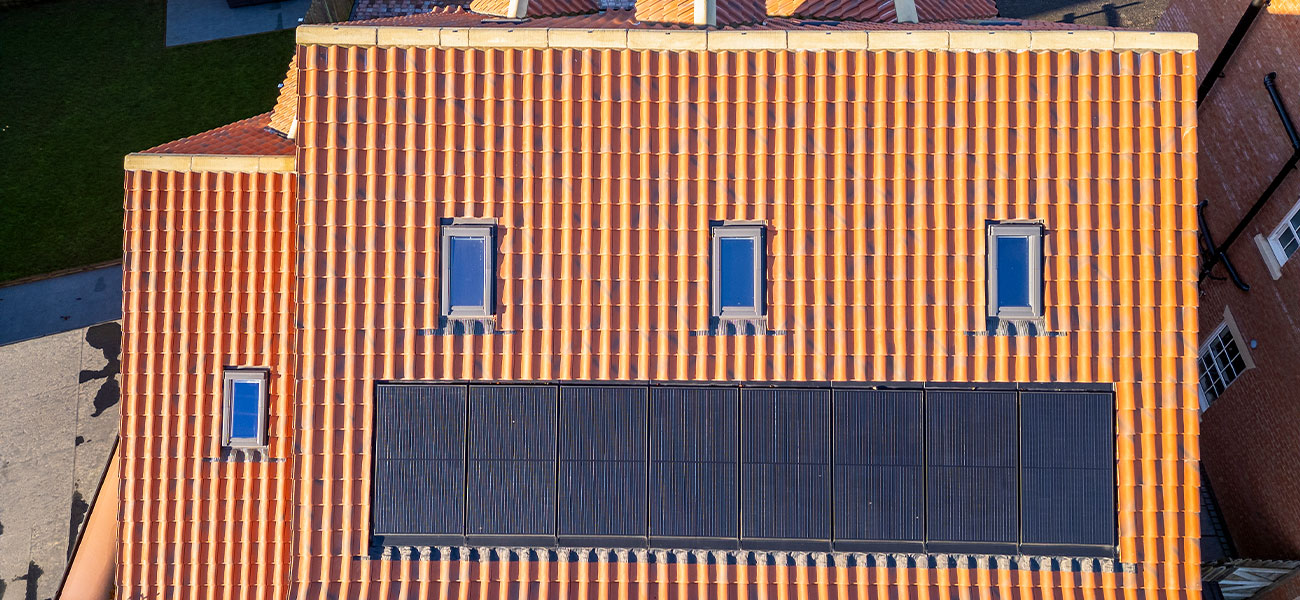
Installing solar PV panels can be an effective way to improve a property's Energy Performance Certificate (EPC) rating, making it more appealing to homeowners and occupants. By generating renewable electricity on site, solar panels reduce reliance on grid electricity, improving a properties calculated energy performance, and contributing to a higher EPC score.
This makes solar PV an important consideration when designing or retrofitting homes. Understanding how EPCs are calculated and the impact that solar PV can have on a property can help developers, architects and homeowners specify the most appropriate solar installation for each project.
What are EPC ratings?
An EPC is an Energy Performance Certificate. It’s a document that provides extensive information about a properties energy performance, including estimated costs, an A (most efficient) to G (least efficient) rating and recommendations to improve efficiency – such as the addition of solar PV.
EPCs were first introduced in 2007 in England and Wales as part of the EU Energy Performance of Buildings Directive. While implementation varied across the UK, they were in widespread use by the end of 2008 and required for most residential and commercial properties being sold or let.
EPCs are based on the modelled performance of a building rather than the actual energy used by its occupants. This means that two identical homes occupied by different households can receive the same EPC rating, even if their energy consumption differs significantly.
Today, EPCs are used throughout England, Scotland, Wales and Northern Ireland. The documents are similar across the devolved administrations, although they differ slightly in presentation and the assessment systems used to produce them.
In England and Wales, the Minimum Energy Efficiency Standard (MEES) requires that most privately rented commercial and residential properties achieve a minimum EPC rating of E. There is currently no equivalent MEES requirement in Scotland or Northern Ireland.
Socially rented homes are not currently required to meet a minimum MEES-style EPC rating. According to the English Housing Survey 2024-2025, only 74% of social homes have an EPC at band A, B or C. The government has set a mandate to ensure that all homes in the social rented sector (SRS) achieve a minimum EPC rating of C by 2030. Similar mandates are in place for Scotland, Wales and Northern Ireland.
Dan Redfern, Head of Marketing Communications at Marley, explains that for many properties in the private or social rented sector, the installation of solar PV could help improve a building’s EPC rating. “Solar PV systems, such as the Marley SolarTile®, can help to reduce reliance on the electricity grid, lowering the calculated energy costs and household energy bills for the occupants” he says.
Across the UK, there is also no minimum EPC rating required for a property to be sold. While it may seem surprising that new-build homes don’t need to achieve a specific EPC rating, energy performance is regulated in other ways, such as Approved Document L and the Future Homes Standard in England. These legislative requirements mean that new-build properties are usually designed with thermally efficient building envelopes, low-energy heating systems and renewable technologies such as solar PV. While Solar PV is not explicity required, it is expected to become one of the most common ways of helping new homes meet these performance requirements. As a result, new build properties achieve EPC ratings in the A to B range.
How are EPCs calculated?
In England, EPCs for new-build properties are currently calculated using the Standard Assessment Procedure (SAP). An approved assessor will gather detailed information about the property – covering everything from wall construction, insulation and window sizes through to heating systems and the use of renewables such as solar PV. These details are then input into specialist software, which calculates the property's energy performance and estimated running costs. This information is used to generate an energy efficiency rating, which is then expressed as an EPC band from A to G.
For existing properties where specific details may not be known or readily available, the Reduced Data Standard Assessment Procedure (RdSAP) is used instead. This is a simplified version of SAP that relies on a combination of on-site observations and default values to model the building’s approximate energy performance.
Following the publication of the Future Homes Standard (FHS), SAP calculations are expected to be replaced by the Home Energy Model (HEM). HEM differs from SAP in several ways, including:
- Number of calculations: Rather than relying on 12 monthly average SAP calculations, HEM uses dynamic thermal simulations at half-hourly intervals throughout the year providing a much more detailed assessment of energy use.
- More detailed modelling of renewables: HEM models renewable performance – including solar PV electricity generation, solar battery storage and heat pump performance – using calculations based on real-world hourly weather data.
- Improved behavioural and operational assumptions: HEM is designed to reflect how homes are actually used, rather than relying on fixed occupancy assumptions.
How does solar impact EPC ratings?
Adding solar panels to a property can improve the EPC rating, and in many cases may increase a home’s performance by a full band or more. The exact effect that solar has on an EPC rating will depend on a variety of factors, including:
- System size
- Roof Orientation
- Shading
- Type of heating system
- Property energy demand
- How much generated electricity is assumed to be used on-site
“We are often asked how many EPC points a property will gain for including solar panels,” Dan notes. “But it’s important to remember that an EPC rating is not actually a points-based system. The final score may be expressed as a numerical score and a letter grade, but the calculation is much more complicated,” he explains.
“That said, depending on the specifics of the property, a solar installation could lead to a property’s EPC score increasing by up to 15 points which could equate to a new band” he adds.
Improving a building’s EPC rating with a solar installation
If you're looking to improve a property's EPC rating with a solar installation, there are several things that can influence how much of an improvement the system delivers:
- Appropriate system size – The larger a solar PV system is, the more electricity it will generate. But bigger doesn’t necessarily mean better for the EPC rating if excess energy is not used. The ideal size will depend on the property’s energy demand, available roof space and overall design.
- South-facing where possible – In the UK, south-facing solar panels receive the greatest amount of sunlight throughout the day, thereby achieving the highest electricity generation and the greatest benefit for a solar EPC calculation. East- and west-facing systems also perform very well, while north-facing systems will also improve an EPC, just with less impact than the other orientations.
- Roof pitch of 30 - 40° - For most locations in the UK, a roof pitch between 30° and 40° is considered best for solar electricity generation although other roof pitches can also perform well.
- Minimal shading – Trees, neighbouring buildings, chimneys and other obstructions can reduce the amount of sunlight that reaches solar panels, thereby reducing how much electricity they generate. EPC calculations take shading into account, so it’s best to avoid sources of shade and maximise the amount of sunlight that reaches the solar system.
- Solar battery inclusion – Incorporating battery storage into the solar system can increase how much solar electricity is used within the property. This is because solar batteries enable the energy generated during the day, when occupants typically aren’t home, to be used in the evenings.
- Use of electric heating systems and heat pumps – In properties that use electric heating systems and heat pumps, solar PV can have a particularly positive impact on the EPC score.
- Building fabric efficiency – When a building envelope has good insulation and high-performance windows, its overall energy demand is reduced, and the electricity generated by solar panels can be used more efficiently. This translates to a greater impact on the property’s EPC rating.
Boost your solar EPC rating with Marley SolarTile®
Marley SolarTile® is an integrated solar system designed for easy installation, efficient energy generation and long-term reliability. With proper specification and installation, Marley SolarTile® can help improve a property’s EPC rating, and it is suitable for both residential and commercial properties with pitched roofs.
To find out more about how Marley can support your next solar roof project, please get in touch.
Disclaimer - The information shared in this blog is correct at the time of publication. Guidance, standards, and best practices may change over time, so if you’d like further clarification or the latest updates, please get in touch with the Marley Technical Advisory Team, who will be happy to help.
Category: Environmental Solar PV Solar Roof Tiles