A guide to residential solar panel specification
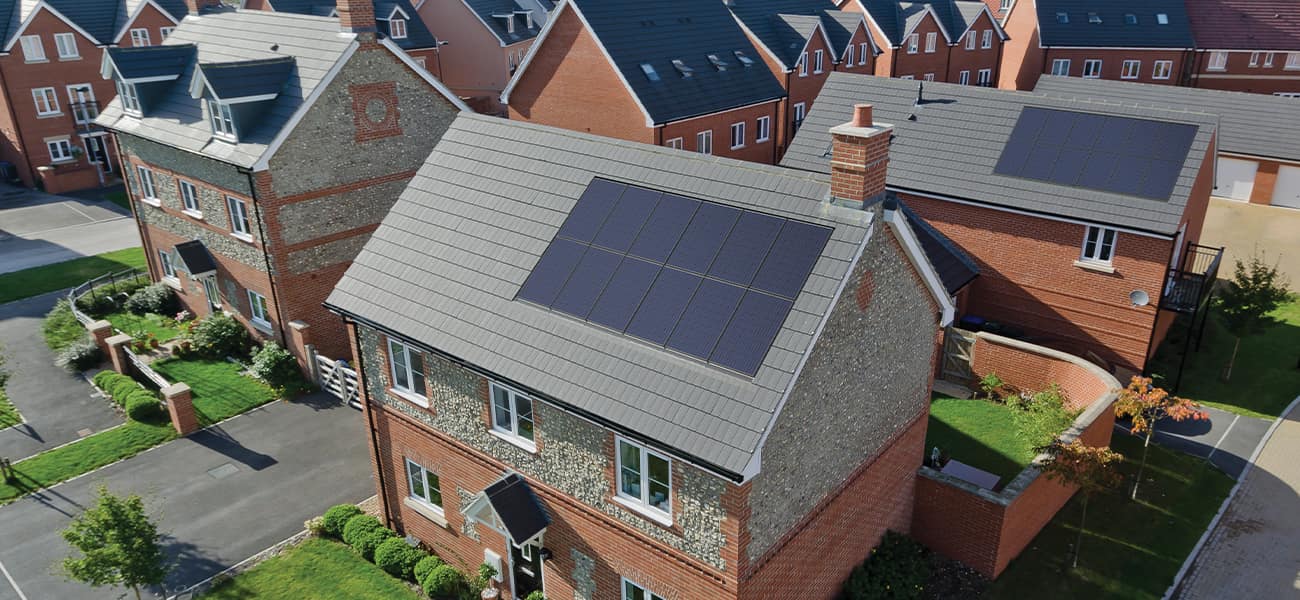

The growing demand for residential solar panels
Across the UK, new-build homes are being designed to meet increasingly demanding energy efficiency and carbon reduction requirements, while home extensions and some housing refurbishments may also be required to achieve minimum energy performance standards.
In England, legislation such as the Future Homes Standard and Approved Document L require developers to reduce operational carbon emissions through improved building fabric and on-site renewable energy generation. Similar legislation is also requiring improvements in the energy efficiency of residential buildings in Scotland, Wales and Northern Ireland.
Today’s homebuyers are also looking for homes with solar PV already installed, as the benefits of these systems include reduced energy costs as well as a lower carbon footprint. So, what do you need to think about when specifying solar panels for dwellings? Let’s look at some of the main considerations.
Residential solar PV specification: safety first
Fire safety is always a top consideration when specifying any part of a building, and it’s certainly important when planning a solar panel installation on a residential dwelling – whether it’s a detached home, a new housing development, terraced social housing or a block of flats.
Kevin Taylor, Training and Technical Support Manager at Marley, explains that solar panels are generally very fire-safe. “All solar panels must have a UKCA mark to be sold in the UK, meaning that they conform to the relevant quality and safety standards. This means that there is minimal risk associated with the solar panels themselves,” he says. “Instead, the risk is mainly with the electrical installation and the DC connectors, which can create electrical arcs if not properly installed,” he warns.
To ensure solar PV installation is safe for a domestic property, be sure that a suitably qualified electrician in installing solar PV makes all the electrical connections on the roof. Other ways that specifiers can mitigate fire risk in dwellings include:
- Opting for in-line solar systems such as Marley SolarTile®
- Using fire-safety products like ArcBox
- Ensuring DC connections comprise components from the same manufacturer
- Installing fire-resistant roofing materials
- Educating homeowners and occupants about the correct use and maintenance of the solar PV system
Specifying residential solar PV panels with adequate capacity
The capacity of a dwelling’s solar system is another important consideration. While specifiers can’t be sure what the energy use of a new household might be, the overall size of the home, the number of bedrooms and the location can all help you estimate a suitable capacity.
Kevin points out that adding solar batteries can also help with domestic solar panel specification. “Batteries enable unused solar-generated electricity to be stored for use later. This is particularly useful for households where the occupants primarily work during the day. Since solar panels generate electricity all day, the batteries will provide free electricity in the evenings when the residents are home,” he says.
Other specification considerations for residential solar systems
As well as fire safety and electrical capacity, there are a number of other things to consider as part of a residential solar panel specification. These include:
- Appearance – While solar panels were once considered environmentally friendly eyesores, many modern arrays are designed to boost a home’s appearance.
- Roof-integrated vs on-roof – Residential solar panels come in two main types. On-roof solar panels are bolted onto the roof, above the roofline. This is generally considered less aesthetically pleasing. It also leaves a gap where debris can build up, or which can serve as a shelter for unwanted pests. Roof-integrated solar panels, such as the Marley SolarTile®, take the place of roof tiles and sit within the roof plane. This provides a more attractive and streamlined appearance for the home.
- Roof pitch and orientation – While south elevations with a 30 to 40-degree pitch will normally provide maximum efficiency, residential solar panels can provide adequate electricity on most east- or west-facing roof elevations between 20 and 60 degrees. North-facing elevations offer the least efficiency.
Residential solar panel specification with Marley
As experts in roofing, Marley offers a complete roofing system that includes everything from the battens and roof tiles to the solar panels and associated equipment. Our products make it easy to specify a safe and attractive residential roof with solar electricity generation while ensuring complete compatibility.
For help with roof or solar panel specification for both residential and commercial buildings, take a look at all of our specification tools, or get in touch with a member of our knowledgeable team.
Disclaimer - The information shared in this blog is correct at the time of publication. Guidance, standards, and best practices may change over time, so if you’d like further clarification or the latest updates, please get in touch with the Marley Technical Advisory Team, who will be happy to help.
Category: Environmental Solar PV Solar Roof Tiles