What are the requirements for warm roof ventilation?
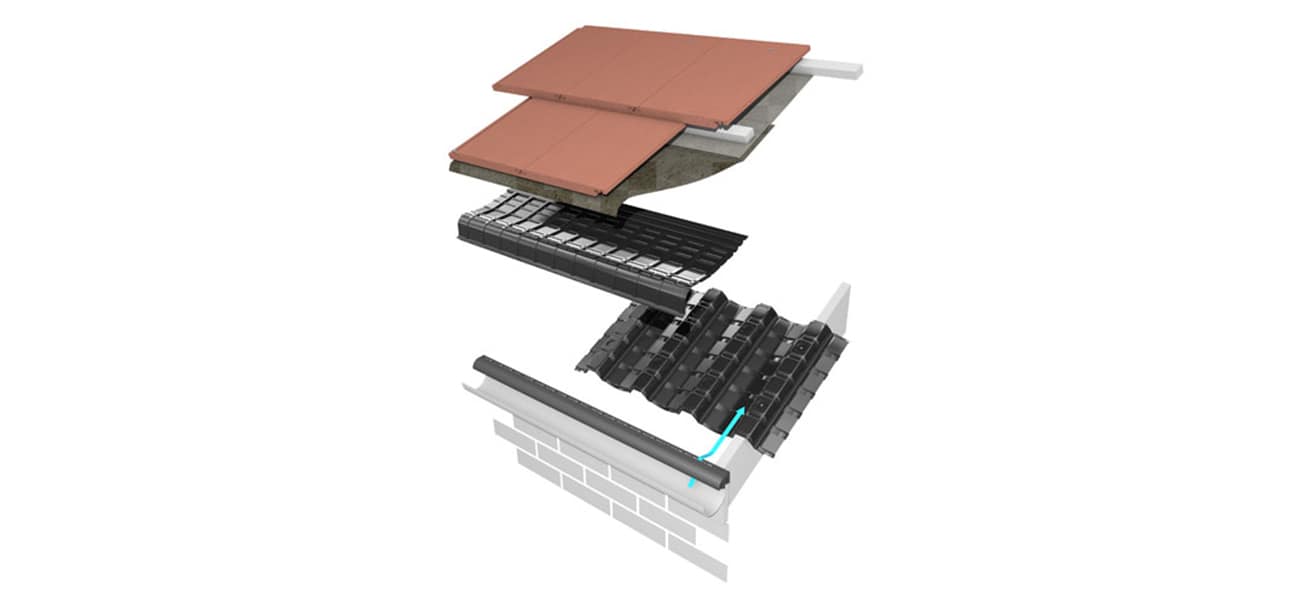

A warm roof is a type of roof construction in which insulation is placed between and/or above the rafters. This makes the roof space warm and potentially habitable.
Because warm roofs are exposed to warm, moist air from the living spaces below, effective ventilation and vapour-control measures are essential to manage moisture and prevent condensation. Several documents provide useful guidance and advice on this topic, including:
- Approved Document C (England) – Site preparation and resistance to contaminants and moisture
- BS 5250:2021 – The code of practice for the management of moisture in buildings
- NHBC 2025 Standards – Chapter 7.2 – Pitched roofs
Warm roof ventilation specification
While previous versions of BS 5250 provided easy-to-quote rules about high- and low-level cross ventilation, the 2021 update takes a much more nuanced approach. It considers the performance of the whole building rather than relying solely on fixed ventilation rates.
Kevin Taylor, Training and Technical Support Manager at Marley, explains: “In warm roof systems, ventilation and air‑flow strategies vary depending on insulation location and type, underlay type, building airtightness and whether the roof covering is air‑permeable or impermeable.” Impermeable roofing includes integrated solar panels, such as the Marley SolarTile®.
“The primary goal is to prevent moisture-laden internal air from reaching cold surfaces where condensation could occur, protecting both the structure and the insulation’s thermal performance,” Kevin adds.
Some key points in BS 5250 include:
- In some warm roofs, ventilation of the batten space (e.g., via counter battens) may not be required if the roof covering is deemed to be sufficiently air permeable, a vapour-permeable underlay is installed, the internal ceiling is airtight and there is a continuous, effective AVCL is in place.
- However, if it not practical to install an AVCL, if a high-resistance (HR) underlay is used, or any of the other conditions cannot be guaranteed, then ventilation of the batten space is necessary.
- Typical guidance for ventilated warm roofs suggests a minimum free area of no less than 25000 mm²/m at eaves and 5,000 mm²/m at the ridge, with a clear airpath of at least 25 mm above the underlay if counter battens are installed directly on top of it, or 25mm plus up to 15mm for underlay drape where the counter battens are installed below it.
- Actual requirements depend on roof pitch, build-up and underlay type.
Kevin explains that correct specification requires a complete understanding of the roof build-up, insulation and underlay types and the products being used. “The most reliable way to ensure compliance is to follow manufacturer guidance and, where needed, carry out a condensation risk assessment in line with BS 5250, and when in doubt, ventilate the batten cavity and at high and low levels” he says.
What the NHBC says about warm roof ventilation specification
The NHBC’s 2025 Standards ( 7.2.15) emphasise that pitched roofs should be adequately ventilated to limit the risk of interstitial condensation. It refers users to the guidance set out in BS 5250.
It warns that new-build homes can be at risk of significant additional moisture load from the construction process, noting that roof-space condensation may occur during the first heating season. Builders are therefore encouraged to take additional precautions beyond what is set out in the British Standard.
The NHBC also explains that ventilation should:
- Prevent the entry of birds and other animals
- Ensure ventilation pathways are not obstructed by insulation or structural elements
- Include eaves spacers to minimise thermal bridging.
- Incorporate eaves ventilators
Good ventilation not only protects the roof structure but also helps maintain the insulation’s thermal performance and contributes to Part L compliance by preventing damp or moisture accumulation that can reduce thermal efficiency.
Warm roof ventilation products and guidance from Marley
Marley provides a range of ventilation products and accessories designed to help achieve the required airflow for a healthy roof space and to comply with BS 5250.
Products include:
- Roof underlays – Vapour-permeable and non-breathable options to suit different project requirements
- Ridge and hip ventilation – The Marley RidgeFast and HipFast dry-fix systems combine secure mechanical fixing with 5mm continuous of integrated ventilation.
- Eaves ventilation – The Marley Universal 25mm Roof Eaves Ventilation System provides continuous airflow to maintain effective roof ventilation.
For more information or guidance on choosing the right ventilation strategy for your project, contact a member of our technical team.
Disclaimer - The information shared in this blog is correct at the time of publication. Guidance, standards, and best practices may change over time, so if you’d like further clarification or the latest updates, please get in touch with the Marley Technical Advisory Team, who will be happy to help.
Category: Accessories Roofing Standards